
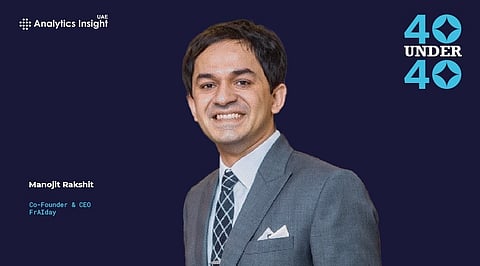
40 Under 40 Innovators 2026: How FrAIday CEO Manojit Rakshit Is Building Trustworthy AI for BFSI Operations
There's a specific kind of chaos I know well. It's 11 PM, a process has broken somewhere, and a room full of smart, exhausted people are doing by hand what no human should ever have to do by hand - checking, copying, reconciling, chasing. I spent fifteen years in rooms like that. And somewhere in the middle of it, I realized the thing quietly deciding whether a company succeeds isn't the strategy on the whiteboard. It's whether the work underneath it actually holds together when the pressure comes.
That's operations. It's unglamorous, invisible when it works, catastrophic when it doesn't - and I fell for it completely.
I'm an engineer who became an operator. I helped build a marketplace from scratch at an online travel startup, then spent years at BharatPe growing distribution and running operations through the kind of hypergrowth that either teaches you everything or breaks you. We went from a small base to millions of merchants at a speed that still feels surreal. What I took from it wasn't a playbook - it was a conviction. Growth never breaks because you run out of ambition. It breaks because the systems you built for a smaller company can't carry a bigger one. The workaround that saved you at ten thousand users will quietly sink you at four million.
For years I watched brilliant people burn their best hours on work a machine should have been doing. It bothered me more than I could justify. So, when AI finally became good enough to do that work - not talk about it, actually do it - I stopped complaining in meetings and left to build the answer.
FrAIday is that answer. I started it with Sunil Saini, who I'd worked alongside at BharatPe - he's the technical and data mind (and one of the sharpest), I'm the business and operations one. We help BFSI enterprises put AI into the real, messy work: the complex workflows, the document checks, the customer queries, the payments that go sideways. Not an agent that says nice things - something that gets the job done and can prove exactly how. Because in banking and insurance, "mostly right" isn't a rough draft. It's an incident waiting to happen. We built for that hard version of the problem on purpose. It's the only version that matters.
What I actually believe, underneath all of it, is this: we're at the start of a shift as big as electricity. Companies won't just use AI - they'll be built around it. The ones that win won't own the fanciest technology; they'll be the ones brave enough to rethink how work gets done, and disciplined enough to make it trustworthy. That's the future I get to build toward every day, and I don't take that for granted.
Away from work, I'm a devoted (read: long-suffering) Manchester United fan, a very relaxed traveller with post-rock in my headphones, and my family beside me - ideally somewhere new, with no fixed plans once we land there.
What inspired you to launch FrAIday after a successful corporate career?
FrAIday is the culmination of my entire journey across the corporate, esp. fintech ecosystems. The biggest bottleneck in enterprises is rarely strategy - it is execution. I saw talented teams spending an enormous amount of time navigating fragmented systems, repetitive processes, compliance checks, and manual decision-making. Businesses were investing heavily in technology, yet many critical operations still depended on human intervention.
When Gen-AI hit its inflection point, I knew we were witnessing a once-in-a-generation architectural shift. For the first time, technology could move beyond automation to intelligent execution. FrAIday was born from that conviction - to build AI that doesn't simply assist enterprises, but works alongside them to execute complex business workflows with enterprise-grade governance and accountability.
For me, entrepreneurship wasn't about leaving corporate life behind. It was about taking everything I had learned from scaling businesses and applying it to solve one of the defining challenges of this decade.
What is the biggest operational challenge FrAIday is solving for BFSI companies?
Getting AI out of the pilot and into the actual job. Almost every company I talk to has run experiments. Very few have anything running in production where it counts. The BFSI industry doesn't struggle with a lack of technology - it is hampered by operational complexity - disconnected systems, endless manual handoffs, document-intensive workflows, and business-critical knowledge that isn't institutionalized. Critical workflows span multiple systems, require strict compliance, involve significant manual effort, and leave little room for error.
FrAIday enables organizations to orchestrate these workflows through SOP aware AI agents that can understand context, execute tasks, maintain auditability, and operate within enterprise governance frameworks. The outcome isn't just efficiency; it's faster decision-making, lower operational risk and overheads, and improved customer experience.
We are essentially proving to the world’s most conservative institutions that they can achieve absolute data sovereignty without sacrificing extreme operational velocity. That's the whole game.
Why do you believe AI adoption in BFSI is accelerating now?
BFSI institutions inherently operate at massive scale - millions of transactions, thousands of daily decisions, and compliance obligations that compound with every interaction. Scale is precisely where AI acts as a true force multiplier. A workflow improvement that saves two minutes per transaction saves millions of hours annually. Boards are no longer asking if they should deploy AI; they are demanding to know how fast they can move it into production.
Essentially, quite a few things finally came together at once. The technology got reliable enough that you can trust it with serious work, not just party tricks. The fear shifted - leaders used to worry about the risk of adopting AI, and now they worry about the risk of falling behind. And, importantly, the technology finally grew up enough to meet the complex needs.
How does FrAIday ensure accuracy and compliance in critical workflows?
We treat it as the starting point, not a feature we add later.
In BFSI, a 90% accuracy rate is actually a catastrophic failure. A single AI hallucination during a payout operations decision, claims decision, or compliance review can carry significant financial and regulatory consequences.
First, our AI agents operate strictly within an enterprise’s SOPs, policies, and business rules - they do not rely on open-ended reasoning for critical workflows. Second, every workflow is governed by automated validation checks, comprehensive audit trails, and intelligent escalation to human reviewers whenever exceptions or anomalies are detected. Everything our agents do is traceable - if someone asks "why did this happen," there's an answer.
AI should augment enterprise decision-making, not become an uncontrollable black box. Our philosophy is that responsible AI isn't a feature - it's the foundation of enterprise adoption.
What key lessons from BharatPe have helped you as a founder?
A few things stuck with me. One, systems break before people do - when something's going wrong at scale, fix the process, don't just push the team harder. Two, moving fast and being disciplined aren't opposites; we moved fast precisely because the operational foundations underneath were solid. Three, you make better decisions when you're close to the actual problem. My best calls came from sitting with the people doing the work, not from a dashboard. I run FrAIday the same way. And four, and equally hard-won, lesson is about operational reality. Regardless of enterprise size, if a tech product isn't intuitive and seamlessly integrated, institutional adoption will fail. We applied this by ensuring FrAIday acts as an invisible, friction-free engine that empowers operators rather than adding to their cognitive load. If a Finance Operations Executive can't use your AI-embedded system without a manual, it isn't enterprise-grade - it's just expensive.
How do you see AI transforming business operations over the next five years?
Today, the most expensive line item in any enterprise isn't headcount or infrastructure - it's the cost of humans acting as connectors between systems that should be talking to each other. Talented people spending their days downloading files, re-keying data, chasing approvals and forwarding emails. That is the status quo we are dismantling.
By 2030, enterprise software will cease to be a passive ledger and become an active execution engine. The shift won't just be operational - it will be organizational. The role of the human operator moves up the value chain entirely: from executor to supervisor, from process follower to exception handler, from task manager to strategic decision-maker.
For BFSI specifically, this means institutions that once needed large ops teams to manage routine volume will redeploy that talent toward judgment-intensive work. This isn't a story about replacing people - it's about finally giving talented operators work worthy of their abilities.
The companies that will define the next decade won't be the ones that adopted AI the earliest. They'll be the ones that redesigned their operating model around it.
What has been the biggest challenge in building FrAIday so far?
Earning trust in an industry that's paid to be suspicious - and rightly so. We're asking financial institutions to let AI near their most sensitive work. You don't win that with a slick demo. You win it slowly, by being reliable, by being able to show your work, and by getting results that hold up under scrutiny. The genuinely hard part was never building agents that work. It was building ones a compliance officer would actually sign off on. The early days involved a very specific education challenge: convincing institutions that they didn't have to choose between cutting-edge AI capability and absolute data security. That felt like an either/or in their minds. Making it an and/both - on-premise deployment, full auditability, SOP-bound execution - required as much product discipline as it did market education. We stopped treating that as a constraint to work around and made it the thing we're best at.
What advice would you give to aspiring entrepreneurs and operations leaders entering the AI space?
Fall for the problem, not the technology. AI is a fantastic hammer and right now everyone's running around looking for nails. Start where the pain is real, expensive, and frankly a bit boring - that's where the lasting businesses get built. Go deep on one thing before you go wide; solving a single ugly problem brilliantly beats half-solving ten. And don't hide behind "I'm the business person" to avoid understanding the tech. You don't need to build the model. You do need to know exactly what it can and can't do - because the edge isn't the AI, it's knowing where to point it.