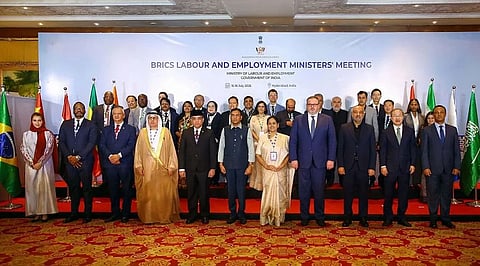


The United Arab Emirates used the 2026 BRICS Labour and Employment Ministers' Meeting, hosted under India's BRICS presidency, to highlight how artificial intelligence is reshaping its labour market. Rather than focusing solely on employment numbers, the UAE presented a broader vision built around AI, digital services, agile regulations, and public-private collaboration to create a more resilient workforce for the future.
The presentation comes as governments worldwide grapple with the dual challenge of accelerating AI adoption while ensuring technology creates new opportunities instead of widening employment gaps. The UAE's approach positions AI as a planning and decision-making tool designed to improve labour market efficiency rather than simply automate jobs.
At the session, the UAE explained how AI has become a key component in its labor market management system. Artificial intelligence tools are employed to examine the trends within the workforce, predict future hiring requirements, enhance labor mobility, and better match employees with available vacancies. The authorities also mentioned how digital tools have facilitated the process of providing services to businesses and employees in regard to employment.
It was stressed that through digital tools and the use of artificial intelligence, policymakers can react faster to changes in economic circumstances due to the possibility of monitoring current trends in employment, skills demand, and development of industries.
The United Arab Emirates cited further growth of employment in the private sector and increased participation of women as evidence of successful implementation of technology reforms to improve the labor market.
One of the prominent themes of the discussion on BRICS was the connection between artificial intelligence and work. Although the fear of losing jobs continues in other parts of the world due to advances in the use of AI, the UAE perceives it as a technology that would help employees become more productive and develop new digital skills.
In fact, this is a broader discussion that is being held in all BRICS countries, where the attention of the government is turning to reskilling, continuous education, and adaptability of the labour force. Thus, it is not just about using artificial intelligence but more about economic and labour policies.
The ability of the UAE to attract international talent is one of the pillars of the policy related to artificial intelligence. The UAE has all the conditions to become a centre of AI startups and professionals due to its well-developed digital infrastructure and visa programmes.
However, the UAE’s presentation went beyond employment numbers as it showed the country’s move towards new government functioning. Artificial intelligence is being incorporated into government services to improve decision-making, speed up the provision of services, and foster collaboration between government organizations and the private sector.
This is consistent with the UAE's strategy on artificial intelligence, in which digital transformation is being implemented across various sectors including healthcare, education, finance, and administration.
Also Read: Top Highest-Paying AI Jobs in UAE: Salary Guide for 2026
The UAE's representation at the BRICS Labor Ministers' Meeting signifies a crucial transformation in the approach of governments toward artificial intelligence. While AI conversations previously centered around automation, efficiency, and innovative technology, it is now evident that artificial intelligence is being used strategically to influence labor markets and policies.
With economies striving to compete for digital investment and skilled workers, it seems natural for the government to use AI insights to predict labor shortages and develop better strategies for employing workers. The presentation by the UAE indicates that the next step in AI adoption would involve much more than businesses and corporations – it would be about designing economic policy based on AI predictions.
For BRICS countries and other developing economies, the message of the event is quite clear, the future success of labor markets could hinge upon the use of artificial intelligence.