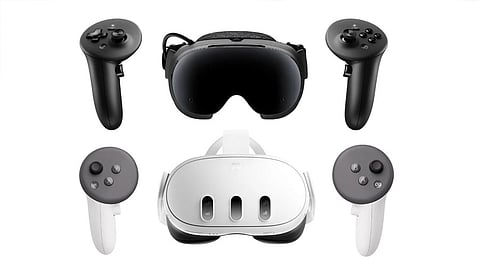


Steam Frame is designed around Steam and PC gaming, while Quest 3 offers a broader standalone VR ecosystem.
Quest 3 has color passthrough and dedicated mixed-reality capabilities, giving it an advantage for MR applications.
Steam Frame brings higher RAM, eye tracking and expandable storage, while Quest 3 offers established hardware and software support.
Valve’s Steam Frame is a new standalone VR headset that takes a different route from Meta Quest 3. Both can run VR without a PC and connect to computers, but their priorities are not the same. Valve built Steam Frame around SteamOS, Steam games, and low-latency PC streaming. Meta Quest 3 comes as a standalone VR and mixed-reality headset, with Meta’s Horizon OS and a large native app and game library.
Steam Frame uses Qualcomm’s Snapdragon 8 Gen 3 and 16GB of RAM, compared with Snapdragon XR2 Gen 2 and 8GB on Quest 3. Valve’s headset has dual 2,160 × 2,160-pixel displays, while Quest 3 uses 2,064 × 2,208 pixels per eye. Both use pancake optics. Steam Frame supports 72Hz to 120Hz, with 144Hz listed as experimental, while Quest 3 goes up to 120Hz. Steam Frame comes in 256GB and 1TB configurations and adds microSD expansion. Quest 3 is available with 512GB of internal storage.
Valve’s biggest distinction is its software and streaming model. Steam Frame runs SteamOS and is designed primarily to stream a user’s Steam library from a PC with low latency, while also supporting standalone VR and non-VR experiences. Valve says the headset supports SteamVR and OpenXR, alongside Windows and Linux PC titles and native ARM64 and Android-based applications. A dedicated wireless adapter is intended for the PC connection.
Quest 3 takes a more conventional standalone approach. Its native library runs through Meta Horizon OS, while PC users can connect through Steam Link, Air Link or a USB cable. That makes Quest 3 flexible for PC VR, but Steam Frame is more directly tied to the Steam ecosystem and PC gaming.
Also Read: How Will the UAE's AI Vision Create New Business Opportunities?
This is a major difference. Quest 3 has full-color passthrough and was designed from the start as a mixed-reality headset. Its cameras let users see their surroundings while virtual objects are placed into the physical environment. Steam Frame uses monochrome passthrough, making it less suited to mixed-reality applications where color and environmental detail are important. For virtual screens and basic awareness, Quest 3 gives you a clearer mixed-reality focus.
Steam Frame’s front module weighs roughly 185-190 grams, with the battery positioned toward the rear of its headstrap. The complete headset is around 440 grams, according to published specifications. Quest 3 weighs about 515 grams with its standard strap. Valve’s rear-mounted battery helps distribute mass across the head rather than placing it all at the front. This helps during longer sessions, although comfort still depends on facial fit, strap adjustment, and accessories.
Steam Frame includes eye tracking, which Valve uses for foveated streaming: the system can send more detailed image data to the area where the user is looking. Quest 3 does not have eye tracking. Steam Frame’s controllers also use a more gamepad-like layout, while Quest 3 comes with Meta’s Touch Plus controllers. Valve adds a microSD slot for storage expansion and a user-accessible expansion port, giving the headset more flexibility for future accessories.
Valve did not announce the Steam Frame’s final retail price or a confirmed launch date. Valve previously targeted a 2026 release, but buyers should wait for an official price and availability announcement. Meta, meanwhile, cut the US price of the 512GB Quest 3 to USD 499.99 in 2024, although regional pricing can differ.
Quest 3 makes more sense for users who want standalone VR, full-color mixed reality and Meta’s established native ecosystem. Steam Frame is more relevant to PC gamers already invested in Steam, SteamVR and wireless PC gaming. Its higher memory, eye tracking and expandable storage add to that appeal. The better choice therefore depends less on raw specifications and more on where your games and preferred VR experiences already live.
Also Read: IFA 2026: TCL Focuses on AI, Ultra-Large TVs
Steam Frame is built around SteamOS and PC gaming, while Meta Quest 3 focuses on standalone VR, mixed reality, color passthrough and Meta’s established software ecosystem.
Steam Frame is specifically designed around Steam gaming and wireless PC streaming, making it particularly appealing to PC gamers with existing Steam libraries and compatible hardware.
Yes. Quest 3 uses color stereoscopic passthrough and a depth sensor, making it better suited to mixed-reality experiences that combine digital content with physical surroundings.
Meta currently lists the 512GB Quest 3 at USD 599.99 in the US following its April 2026 price increase. Regional prices may vary by market.
Steam currently lists Steam Frame as ‘Coming soon,’ so buyers should wait for Valve to announce confirmed launch timing, final pricing and regional availability.