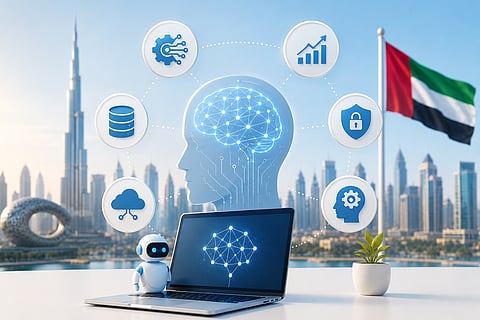


The UAE wants to be an AI capital, not just an AI user. Government strategy, sovereign investment and a fast-growing startup scene are pushing demand for talent far beyond coding basics. By 2030, the professionals who thrive will combine technical depth with the judgment to apply AI responsibly. Here are the skill sets set to matter most.
Building and deploying models remains the core skill behind every AI product. Employers want people who can move a model from notebook to production, handle data pipelines and keep systems running at scale. In the UAE, this skill is central to banking, logistics and government digitisation projects, where reliability matters as much as accuracy.
Large language models now sit inside customer service, content and internal tools across Emirati companies. Getting useful output from these models is its own discipline. Professionals who can design prompts, chain multiple models together and evaluate output quality will find steady demand, especially in media, retail and public sector communication.
The UAE has been vocal about responsible AI, publishing national guidelines and pushing regulation ahead of many peers. Companies need people who understand bias, data privacy and compliance frameworks well enough to translate them into practical policy. This skill sits at the intersection of law, policy and technology, and few professionals currently combine all three.
Every AI initiative depends on clean, well-structured data. Data engineers who can build pipelines, manage cloud infrastructure and support real-time analytics will be needed across sectors from oil and gas to fintech. Dubai and Abu Dhabi's cloud investments make this a safe long-term bet for anyone entering the field now.
AI systems introduce new attack surfaces, from data poisoning to model theft. Security professionals who understand how machine learning pipelines can be exploited, not just traditional networks, will become essential. The UAE's push into smart cities and connected infrastructure raises the stakes for this skill considerably.
Generic AI knowledge only goes so far. Healthcare providers want professionals who understand both diagnostics and machine learning. Banks want risk analysts fluent in AI-driven fraud detection. Logistics firms want supply chain specialists who can apply predictive models. The UAE's economic diversification means this cross-disciplinary fluency will carry real premium value.
As AI tools reach more consumers and government services, designing interfaces that people trust and understand becomes critical. UX professionals who grasp how AI systems make decisions, and can communicate that clearly to end users, will shape adoption across public services and private apps alike.
Technical depth alone will not carry professionals through the next five years. The UAE's ambitions call for people who can build AI systems, govern them responsibly and apply them to real industry problems. Those who develop this blend of skills now will be well placed for 2030 and beyond.