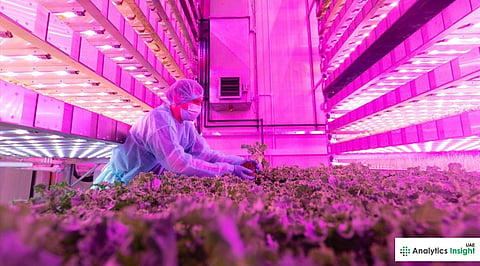


The UAE is changing its approach to food security by swapping traditional open-air fields for high-tech indoor farms. The nation currently imports nearly 90% of its food due to dry desert land and scarce freshwater according to a Khaleej Times report. Now, it is investing heavily in artificial intelligence and vertical farming to build a self-sufficient food network.
Backed by the National Food Security Strategy 2051, this transition moves food production completely away from weather dependencies. It relies instead on automation and climate engineering to protect against global supply shocks.
Local facilities show how quickly this tech-first farming is scaling up across the emirates. A newly launched 10,000-square-metre vertical indoor facility in Al Ain is set to produce 150,000 kilograms of tomatoes every year. This automated greenhouse uses AI systems to monitor and change indoor humidity, carbon dioxide levels, lighting, and airflow around the clock. By keeping growing conditions perfectly stable, these smart setups grow high-quality produce steadily all year long, even through the harsh summer heat waves.
Beyond everyday vegetables, indoor agricultural hubs are successfully localizing specialty crops, rare herbs, and microgreens. These are the same food items that local businesses previously had to fly in from Europe and Asia.
Since vertical farms are near major urban cities, local supermarkets and hospitality businesses can receive fresh produce within 24 to 48 hours of harvest. This drastically cuts down costs incurred for transport travel, lowers food spoilage rates, and international shipping.
The true breakthrough of this desert tech is its water savings. These indoor hydroponic systems use up to 90% less water than traditional open-ground farming. By using smart sensors to control irrigation and track exact nutrient needs, the country manages its limited water resources very carefully.
The food strategy also expands past farming into local manufacturing and packaging. It ensures that thousands of tonnes of material for agricultural supply chains are sourced within the borders. Thus, creating a secure domestic network.
Also Read: How UAE is Becoming the AI Capital of the Middle East: Strategy, Investments, and Future Vision
The UAE is turning its harsh climate into a global testing ground for climate-adaptive technology. Instead of viewing the desert as a barrier, the nation is using environmental constraints to build highly efficient systems.
As climate change brings water shortages and erratic weather across the globe, outdoor farming is getting harder. The automation and indoor farming methods perfected here will soon become valuable tools for global food production. The nation is successfully shifting its role from a simple food buyer to a creator of next-generation agricultural solutions.