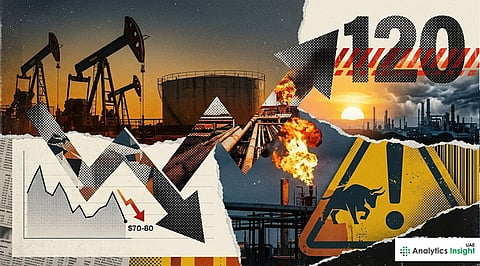


Oil prices have eased slightly, but analysts warn that supply risks could push crude above $120, raising concerns about global energy markets and inflationary pressures. At least 13 vessels were forced to reroute and move away from the areas Iran has claimed in its control zone in the strait, meaning tension has risen sharply.
Oil prices eased on Tuesday (May 5, 2026) after gaining nearly 6 percent a day earlier. However, analysts warn that the market remains vulnerable, and any flare-up in the Strait of Hormuz could push crude above the critical $ 120-a-barrel threshold.
Brent, the benchmark for two-thirds of the world's oil, was trading 2.10 percent lower at $112.04 a barrel at 4.20 pm UAE time. West Texas Intermediate, the gauge that tracks US crude, was down more than 3.22 percent at $102.44 per barrel.
The US may be easing Iran’s blockade of the strait, raising hopes of renewed supply from the Middle East. The biggest risk for the global oil market is the “re-emergence of energy infrastructure” as a target, said Mr. Valecha.
Ipek Ozkardeskaya, senior analyst at Swissquote Bank, said the flare-up on Monday (ii, with US and Iranian forces exchanging fire in the narrow waterway, has injected significant volatility into the market.
Some analysts argue the scale of the supply shock may be less severe than initially anticipated. Economists at Julius Baer are of the view that, while oil storage levels are declining due to disrupted energy flows, the pace of decline remains manageable.
A fragile US-Iran ceasefire appeared to be holding on Tuesday morning, despite the previous day of clashes in the Strait of Hormuz and missile and drone attacks targeting the UAE. The UAE Foreign Ministry accused Iran of a “terrorist attack” on Monday, when Tehran launched a drone attack on a vessel affiliated with the Abu Dhabi National Oil Company while it crossed the Strait of Hormuz.
“The $115-$120 range is acting as a strong resistance. Above this level, the narrative shifts from supply constraints to demand destruction,” Ms Ozkardeskaya said, highlighting rising inflation expectations, tighter monetary policy and higher yields as limiting factors.
Giovanni Staunovo, strategist at UBS, however, said the path for crude prices remains skewed to the upside as long as flows through the strait are limited. "The direction for price is dependent on how many barrels for how long are disrupted via the strait", he told The National.