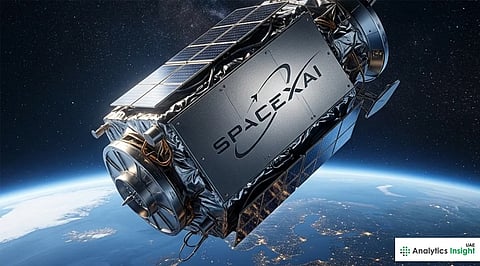


SpaceX plans to begin testing space-based artificial intelligence computing systems by late 2027. This announcement is moving ahead of the timeline outlined in its IPO filing. This news has breaked by two people who attended investor presentations held before the company's public offering.
The orbital computing project has emerged as a key pillar of SpaceX's long-term growth strategy. Company executives told investors that initial missions will focus on validating the technology before moving toward wider commercial deployment.
SpaceX's IPO filing stated that orbital data-center deployments could start as early as 2028. During recent meetings with investors, executives clarified that demonstration systems are expected to launch a year earlier, giving the company an opportunity to test critical capabilities in orbit.
The presentations were led by President Gwynne Shotwell and Chief Financial Officer Bret Johnsen. Both executives have been meeting investment banks and institutional investors as part of SpaceX's IPO process, which seeks to raise $75 billion at a targeted valuation of $1.75 trillion.
SpaceX has positioned orbital computing as a major future business. In its IPO documents, the company said it sees itself as uniquely placed to build large-scale AI computing infrastructure in space. The company has also sought regulatory approval to deploy up to one million satellites designed to function as space-based data centres.
These satellites would form the backbone of an orbital network capable of handling AI workloads outside Earth's atmosphere. Management presented the 2028 timeline as a broader deployment target, while the planned 2027 missions would serve as technology demonstrations.
The success of the project depends heavily on Starship, SpaceX's fully reusable launch vehicle. The rocket is expected to play a central role in transporting large numbers of computing satellites into orbit. Starship has yet to prove the rapid turnaround capability needed for large-scale deployment.
The vehicle is running well behind Elon Musk's previous development schedules, creating uncertainty around the pace of expansion. Michael Monaghan, a partner and portfolio manager at Founder ETFs, said building data centres in space is a complex task. However, he believes it is a more defined and achievable goal than some of Elon Musk's other ambitious projects.
Musk recently confirmed that most of the technology required for orbital AI infrastructure already exists within the company's Starlink satellite network. He argued that building data centres in space is a manageable engineering task rather than a breakthrough scientific challenge.
According to Musk, the first generation of AI satellites is expected to use NVIDIA chips. He said each satellite could deliver computing power comparable to an NVIDIA GB300 rack. SpaceX shares are scheduled to begin trading on Nasdaq under the ticker symbol SPCX.
Investors will be watching closely to see whether the company can turn its ambitious orbital computing vision into a viable business over the next several years.
Also Read: Project Suncatcher: Can SpaceX & Google Move AI to Space?