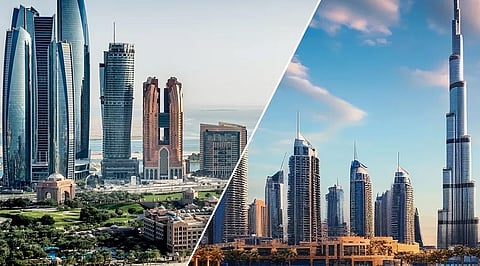


Dubai offers startups access to international customers, private investors, global talent and strong business networks across technology, trade and consumer industries.
Abu Dhabi attracts founders through government-backed funding, Hub71 support, competitive office options and opportunities in AI, fintech, healthcare and clean energy.
Both emirates follow federal corporate tax and VAT rules, while licensing costs, free zone choices and regulatory requirements differ.
Choosing a home for a new company is one of the first and most important decisions any founder makes. A good location shapes the cost of getting started, the people who can be hired, the investors who will take a meeting and the customers who will notice the product. The United Arab Emirates has drawn many founders with open ownership rules, strong airports and steady government support. Two emirates attract the most attention: Dubai and Abu Dhabi. Both are strong places to build, yet they serve different types of business needs, and the right choice depends on what a company plans to sell and to whom.
Dubai is known as a center for trade, tourism, technology and consumer brands, which gives founders quick access to buyers and a large pool of international talent. Abu Dhabi leans toward energy, finance, advanced industry and government-linked projects, and it offers a calm setting for companies that want long term partners. The Leela International comparison describes Dubai as a hub with strong private investment and Abu Dhabi as a place with government-backed funding and grants. These roles do not exclude each other, and many founders use one emirate to test a market and the other to build deeper institutional ties.
Also Read: How UAE Startups Can Secure Funding and Attract Investors
Startup Genome placed Abu Dhabi among the top 50 emerging startup ecosystems in its 2026 report, with an ecosystem value of USD 73.4 billion, up 3,057 % from the 2018 to 2020 period. Abu Dhabi also ranked fourth in MENA for performance and fifth for funding momentum. Hub71, the flagship startup platform in the emirate, has helped facilitate more than USD 2.7 billion in funding since 2019. Dubai held an ecosystem value of about USD 21 billion and ranked 19th among emerging ecosystems in the 2025 edition. Since the two reports cover different periods, the figures work best as signals and not as a direct contest.
The table below pulls together the main differences described by the Leela International and HFA Firm comparisons.
Cost is often the first comparison founders make. HFA Firm notes that office rents in prime Dubai areas can pass AED 20,000 a year, while Abu Dhabi offers more varied and competitive options. The same source reports 16% growth in new Abu Dhabi economic licenses in 2024 and mentions fee reductions above 90% in some cases. Even so, Legal Corner advises founders to avoid judging only by the first year license price, since rent, visas, approvals and renewals add up over several years. A realistic budget that covers three years gives a far clearer view than any advertised package.
Dubai tops many global lists for foreign direct investment projects, and Seed Group counted 801 projects worth AED 21.85 billion in the first half of 2024. The city also lies at the crossroads of Europe, Asia and Africa, with about 2.5 billion consumers within a four-hour flight, according to HFA Firm. This reach suits companies selling to global customers. Abu Dhabi works well for founders in artificial intelligence, fintech, healthcare and clean energy who want close links with Hub71 and the Abu Dhabi Global Market. Talent is available in both emirates, though living costs in Dubai tend to run higher, which can raise salary demands.
Corporate tax and VAT follow federal rules, so choosing Dubai or Abu Dhabi does not create two separate tax systems. A free zone license also does not guarantee a zero tax result, since special treatment applies only to qualifying free zone persons and qualifying income. Full foreign ownership is now allowed across many activities, although strategic activities and regulated sectors carry extra conditions. Financial businesses should also study the Dubai International Financial Centre and the Abu Dhabi Global Market, which have their own legal frameworks. Banking approval depends on the strength of the business plan, and neither emirate makes it automatic.
Recent market commentary describes Abu Dhabi as strong for capital, regulated sectors and founder support, and Dubai as strong for commercial access, visibility and customer density. A company may register in Dubai to test demand and build brand visibility, then open an Abu Dhabi presence when it needs ADGM regulation, Hub71 support or a government partner. Others start in Abu Dhabi with lower costs and grant support, then add a Dubai office for customer growth. Before deciding, founders should confirm the exact licensed activity, map where customers are located, compare mainland and free zone options, check premises rules and plan for visas and hiring.
Dubai and Abu Dhabi each offer real strengths to founders, and neither is the better choice for every company. Dubai suits businesses that need speed, global exposure and a dense customer base, while Abu Dhabi suits those that value funding support, regulated pathways and lower entry costs. The most reliable approach is to define the business activity first, calculate the full cost over several years and speak with licensing authorities before signing any lease. Founders who match the emirate to their own plans, and who stay open to using both, will be well placed to grow in the UAE.
Also Read: Abu Dhabi Opens MENA’s First 6G Summit in the AI Era: Key Details
Dubai is suitable for startups targeting international customers, private investors and retail markets. Abu Dhabi may suit technology- and research-focused companies seeking institutional support, funding programs and access to government-backed initiatives.
Both cities offer funding opportunities. Abu Dhabi's Hub71 community had secured more than $2.7 billion in funding by the end of 2025. Dubai offers access to private investors, venture capital firms and international funding networks.
Abu Dhabi entered the global top 50 emerging startup ecosystems in the 2026 Startup Genome report. Its ecosystem value reached USD 73.4 billion, reflecting significant growth in startup activity, investment and innovation.
Hub71 connects startups with investors, corporate partners, regulators and talent. Its Access Program offers selected companies financial and in-kind incentives, helping founders establish operations and develop their businesses in Abu Dhabi.
No. Both emirates follow the UAE's federal corporate tax framework. Eligible free zone companies may receive a 0% rate on qualifying income if they meet the required conditions. Other taxable income may attract 9% corporate tax.