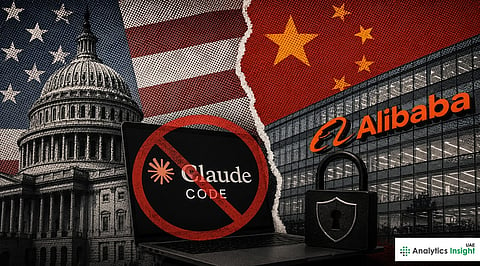


Alibaba will bar its workers from using Claude Code, the AI coding assistant provided by Anthropic, from July 10 onwards. This comes after the company flagged the software as a potential security threat. The technology firm from China has asked employees to use its own coding assistant, Qoder.
This represents yet another point of contention arising out of the escalating war between the U.S. and China in relation to AI.
According to Alibaba, certain versions of the software reportedly included a feature that could detect whether a user was located in China or associated with Chinese artificial intelligence firms. Alibaba described this as a potential backdoor risk.
Anthropic has refuted claims that the feature had any purpose beyond being an experiment. According to Anthropic, the motive behind developing such a feature was to curb unauthorized resale and distillation of AI models. They said that they have already developed better security measures for that purpose.
Anthropic’s Thariq Shihipar further said in a post on X, “This was an experiment we launched in March that was meant to prevent account abuse from unauthorized resellers and protect against distillation. The team has landed stronger mitigations since then, and we’ve actually been meaning to take this down for a while.”
The workplace ban follows a public dispute between the two companies. A few weeks back, Anthropic claimed that entities associated with Alibaba engaged in one of the largest-ever distillation exercises of AI models. The US-based AI firm alleged that operators connected to Alibaba used thousands of fake accounts and millions of transactions to distill Claude's capabilities and train competing AI models.
This move comes as part of a larger trend within the AI landscape in China. As US export controls tighten and American AI companies impose stricter access restrictions on their services, Chinese tech companies are increasingly speeding up their efforts to develop their own AI systems and development tools.
The move to replace Claude Code with Qoder reflects a growing preference for domestically developed AI software as geopolitical tensions continue to rise.