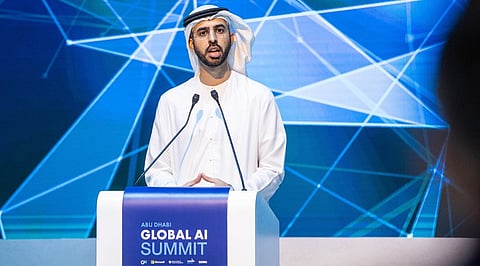


The UAE has moved past simple AI ambition. Abu Dhabi now hosts major AI projects, large pools of technology capital, advanced research centers and some of the world's biggest technology firms. The country also wants AI to reshape government services, health care, energy and transport.
The UAE has money, energy, infrastructure and strong government support. It still needs deeper local talent, chip expertise, original software companies and more home-grown research to match the world's strongest technology powers.
The clearest sign of the UAE's rise comes from the scale of its AI infrastructure.
OpenAI launched Stargate UAE with G42, Oracle, NVIDIA, Cisco and SoftBank. The plan includes a 1 GW AI cluster in Abu Dhabi, with 200 MW set for 2026. The project also links UAE investment with wider Stargate infrastructure in the United States. OpenAI says the partnership will support AI use across government, energy, health care, education and transport.
Microsoft and G42 also have a major role in the country's AI plans. Microsoft has committed USD 15.2 billion to the UAE, while a 200 MW data center expansion adds more capacity to the country's digital base.
This matters for a simple reason. Modern AI needs huge amounts of computing power, electricity, data and secure data centers. The UAE has strong access to all four.
Abu Dhabi also has a major advantage that many new technology hubs lack: vast pools of state-backed capital. That money can support data centers, AI firms, research centers and global technology deals at the same time.
The UAE does not want to remain only a buyer of foreign AI systems. Recent model releases show a clear effort to develop original AI technology inside the country.
On September 3, Abu Dhabi's Institute of Foundation Models released K2 Horizon, a set of six open AI models. The release covers model code, data, methods and development checkpoints. The largest model has 375 billion parameters and targets large enterprise use. Reuters described the release as a major step toward full openness in AI model development.
This approach gives the UAE a clear identity in the global AI race. The country can focus on open models, sovereign AI and systems that serve Arabic and other regional needs.
MBZUAI, or Mohamed bin Zayed University of Artificial Intelligence, also gives the country a serious research base. Its work covers natural language processing, robotics, computer science and other AI fields. Such institutions can help create local expertise rather than rely only on imported talent.
The UAE government has taken one of the boldest steps in the world with its Agentic AI plan. In April, the UAE announced a target to move 50% of government sectors, services and operations to Agentic AI within two years. Agentic AI refers to systems that can carry out tasks and make decisions with limited human action.
In May, the Cabinet approved the wider framework and launched a programme for 80,000 federal employees. The first group of AI agents covers procurement, tax audit, customer service and technical support.
This gives companies operating in the UAE something very valuable: a large domestic market for real-world AI deployment. Government agencies can test new systems at scale, measure results and create products for wider markets.
The UAE still faces one major weakness. Much of the core technology behind its AI plans comes from outside the country.
NVIDIA supplies key AI chips. OpenAI and Microsoft provide major AI and cloud technology. Oracle supplies cloud infrastructure. Other advanced parts of the AI chain also depend on companies based in the United States and Asia.
That does not stop the UAE from becoming an AI power. It does, however, limit full technology independence.
A true global technology leader needs more than large data centers and foreign partnerships. The UAE needs major local software firms, stronger chip design skills, deeper scientific research and a much larger pool of home-grown engineers and researchers.
The country has made progress on talent. MBZUAI now has students and researchers from more than 50 countries, while its 2026 graduating class had 140 graduates from 23 countries. Such talent can help Abu Dhabi build a stronger research culture.
Also Read - How Will the UAE's AI Vision Create New Business Opportunities?
The strongest path for the UAE may not involve a direct race with Silicon Valley or China. A more realistic goal lies in a different position.
The UAE can become a global center for AI infrastructure, capital, sovereign AI and large-scale AI use. Its energy resources can support data centers. Its capital can fund major technology deals. Its government can create a large test market. Its universities can support research. Its location can connect Asian, European, American and Middle Eastern technology markets.
The latest K2 Horizon release adds another piece to that strategy. It shows that Abu Dhabi now wants to create AI models, not only host the infrastructure that run them.
That shift could define the UAE's technology future. If local research turns into major companies, strong intellectual property and globally used AI products, the country could move from a major technology hub to a genuine technology power.
The UAE does not need to build every part of the global technology stack to achieve that goal. It needs to turn its money, infrastructure and government support into lasting local expertise. That is the point where AI could change the UAE from a powerful technology customer into a technology creator.