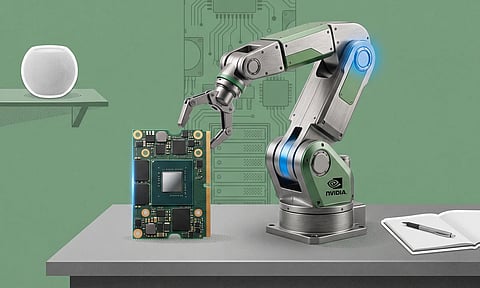


NVIDIA introduced two new additions to its Jetson Thor family: the Jetson Thor T3000 and Jetson Thor T2000, accelerating the development of robots and edge AI systems. The new modules are based on the company's Blackwell architecture.
These modules target a growing market for physical AI, where intelligent machines operate in factories, warehouses, hospitals and other real-world environments. The launch broadens NVIDIA's robotics portfolio with compact, energy-efficient computing platforms that balance performance, size and cost.
The Jetson Thor T3000 is aimed at sophisticated AI workloads for robotics that do not require additional power or a larger form factor. The module delivers up to 865 FP4 TFLOPS of AI performance with 32 GB of memory.
According to NVIDIA, “The Jetson T3000 has the same inference abilities as the high-performance Jetson T5000 but consumes almost half the energy and has much smaller dimensions.” The T3000 is perfect for use in humanoid robots, self-driving mobile robots, industrial machinery and visual AI workloads.
NVIDIA has developed the Jetson Thor T2000 for those developers who want to have access to an inexpensive platform for robotics and embedded AI. The T2000 is capable of delivering 400 FP4 TFLOPS of AI performance with 16 GB of memory. Developers can use it to run generative AI models and vision-based applications on edge devices.
NVIDIA has also announced software enhancements to the Jetson platform. These include memory optimization strategies and agent capabilities that enable developers to deploy large AI models even when limited resources are available. It will also add new modules to its Isaac robotics platform and physical AI ecosystem. The aim is to allow developers to build autonomous systems more easily.
The launch comes as demand grows for AI-powered robots capable of performing complex real-world tasks. With the introduction of mid-range Jetson Thor modules, NVIDIA seeks to lower the barriers to advanced robotics and expand its footprint in the rapidly growing physical AI sector.
Also Read: NVIDIA Introduces Revenue-Sharing Financing Model for AI Cloud Expansion