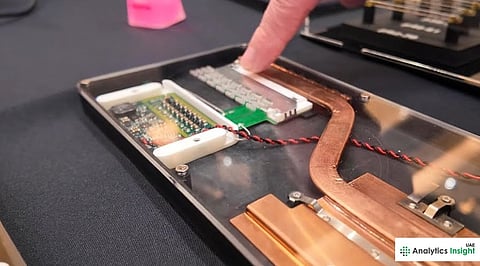


High-performance laptops are moving toward a quieter era as solid-state cooling enters real-world testing. Ventiva presented its electrohydrodynamic cooling system at Computex 2026. The concept replaces spinning fans with plasma-driven airflow and signals a shift in how thin laptops manage heat.
Electrohydrodynamics, also known as EHD, uses a thin charged wire to generate a plasma field that strips ions from the surrounding air. These ions move toward a negative collector and pull neutral air molecules along their path. The movement produces continuous airflow without blades or motors. The system operates without vibration and reduces acoustic output to near-silence levels in laptops.
Next-gen AI PCs using chips like Nvidia RTX Spark and AMD Strix Halo demand high memory bandwidth and tighter component layouts. Traditional cooling systems with dual fans occupy 40-45% of the motherboard area, close to 8,000 square millimeters, in thin laptops. Removing these assemblies frees up layout space for memory closer to processors, improving data routing efficiency and reducing the need for signal repeaters, which add cost. Intel Panther Lake processors also push design teams to rethink cooling placement in compact devices.
This shift carries strong relevance for UAE users who move between air-conditioned offices and outdoor environments. Eliminating fan assemblies allows manufacturers to increase battery capacity in 14-inch laptops from 65Wh to nearly 90Wh without increasing thickness. Extended battery life adds four to five hours of additional usage for travel and workdays. Solid-state airflow systems also reduce dust intake, a common issue that affects long-term performance in Gulf conditions.
Ventiva has shown prototypes through a partnership with Asus at Computex 2026, covering devices such as the Asus NUC Pro 16 and AMD Ryzen laptop designs. Early expectations point to a commercial launch within 18 months, placing availability in late 2027 or early 2028. Pricing is expected to start in the premium range, around AED 7500 to 9000. Manufacturing changes keep total costs closer to those of current high-end gaming laptops despite the new cooling architecture.
Consumers choosing between current gaming laptops and upcoming models weigh immediate performance needs against anticipated silent-cooling gains. Current machines deliver strong thermal control with improved fan designs that handle demanding workloads. Upcoming systems with solid-state cooling target quieter operation and improved battery efficiency while reshaping internal layouts. Servers for the next generation may see gains in silence, battery life, and compact design.
Also Read: Acer Reveals Snapdragon-Powered AI Laptops for Productivity and Mobility