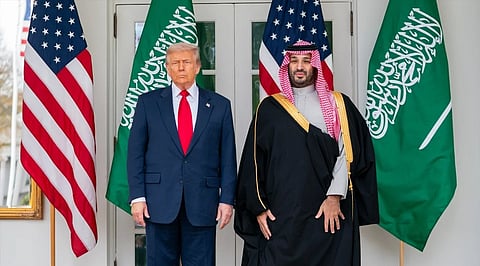


The United States and Saudi Arabia have signed a landmark civil nuclear cooperation agreement that could reshape energy ties, strategic calculations and the non-proliferation debate across West Asia. The pact creates a legal framework for a decades-long, multibillion-dollar partnership and gives American companies a significant role in Saudi Arabia’s nuclear programme. But the deal’s biggest implications extend far beyond reactor contracts.
The agreement is signed by US Energy Secretary Chris Wright and Saudi Energy Minister Prince Abdulaziz bin Salman. Thus, allowing American companies greater access to Saudi Arabia’s planned nuclear energy programme. Riyadh wants nuclear power to support its growing electricity needs and reduce its dependence on oil and gas for domestic consumption.
However, the agreement also serves Washington’s commercial and geopolitical interests. The US is trying to increase its nuclear energy exports and ensure that competitors like Russia and China do not gain a greater stake in this strategically vital market.
This is why the agreement is not only an energy alliance but also a bid by Washington to maintain influence over Saudi Arabia’s energy infrastructure for years to come. The pact also has economic and political implications for Washington.
The U.S. is keen on increasing the export of its civil nuclear energy program and preventing other nations like Russia and China from increasing their presence in this strategic market.
Thus, the pact goes beyond being just an energy alliance. It is, in effect, Washington’s strategy to gain influence over the vital energy facilities of Saudi Arabia.
The most sensitive issue is uranium enrichment. Saudi Arabia has long argued that it should have the right to develop a complete civilian nuclear fuel cycle, including the ability to enrich uranium and process spent nuclear fuel.
The problem is that enrichment technology has a dual-use character. Low-enriched uranium can fuel nuclear reactors, while highly enriched uranium can be used in nuclear weapons.
According to Reuters, “ The agreement creates a legal pathway for cooperation on sensitive parts of the nuclear fuel cycle. However, it does not necessarily require Washington to transfer enrichment technology or capabilities to Riyadh. The distinction matters! The pact may open the door to future cooperation without automatically handing Saudi Arabia the means to produce weapons-grade material.”
However, the arrangement has already raised concerns because it differs from the stricter precedent set by the 2009 US-UAE nuclear agreement. Abu Dhabi renounced uranium enrichment and plutonium reprocessing under that deal. The Saudi arrangement does not appear to impose the same blanket restriction.
Saudi Arabia’s nuclear ambitions cannot be separated from its rivalry with Iran. The Saudis have been known to view the nuclear program of the Iranians with great suspicion. The Saudi crown prince, Mohammed bin Salman, has been quoted as saying that his nation may pursue nuclear arms if Iran succeeds in obtaining them.
This agreement comes as a very significant development. The United States is stepping up cooperation with Saudi Arabia when the nuclear program of Iran is still a matter of grave security concern in the region.
It is not the immediate acquisition of a nuclear weapon by the Saudis through the agreement that poses a potential threat. The threat is posed by the possibility that the agreement could set a dangerous regional precedent where other nations would start demanding equal rights to nuclear technology.
The agreement reflects a difficult calculation for Washington. The US aims to bolster its relationship with Saudi Arabia, gain profitable contracts for American nuclear firms, and prevent Russia and China from making inroads. However, on the other side, Saudi Arabia desires to acquire technology and strategic independence.
However, as the US grants more leeway to Saudi Arabia, it becomes increasingly difficult for the former to uphold a coherent non-proliferation policy. This is because the US has always insisted on robust non-proliferation measures in negotiations involving the signing of nuclear cooperation agreements.
If the deal remains tightly controlled and backed by strong inspections, it could become a model for responsible civilian nuclear cooperation. If safeguards remain ambiguous, it could encourage a broader regional race for nuclear capabilities. The agreement, therefore, is not simply about building reactors. It is about who controls the region’s strategic technologies—and how far West Asia is willing to move towards a new nuclear age
Also Read; Inside Stargate UAE: How Abu Dhabi is Building the World's Next AI Superhub